Medinet Habu & 'Sea Peoples'
The name [Sea Peoples], like so many labels associated with ancient events of great complexity, is (as all serious archaeologists readily acknowledge) a misnomer. The label merely acts as a “tag” or “shorthand” to identify a series of people and cultural events involving those who attacked Egypt at the time of Ramesses III. The events that were associated with the Sea Peoples are more easily identified by their effects than by their causes.
Philip P. Betancourt, The Aegean and the Origin of the Sea Peoples

Medinet Habu pictured, an archeological site in the Theban Hills of Egypt. The site is home to
the Mortuary Temple of Ramesses III, where the inscriptions of the Sea Peoples were found.
Perhaps the first thing for historians and enthusiasts alike to agree on is, who were the Sea
Peoples? More specifically, who exactly are we referring to when referencing the term "Sea
Peoples"? The definition provided by Betancourt above is a good starting point, and largely
something historians and enthusiasts can agree on. However, it still leaves much to be said. The
root of our understanding of the Sea Peoples comes from the inscriptions of Ramesses III at
Medinet Habu, where he describes the Sea Peoples as he defeated them at the Battle of the Delta.
The inscriptions are the primary source of information about the Sea Peoples, and have been used
to identify the various tribes that made up the Sea Peoples, as well as theorize about their
origins and motivations. Economic downturns, social shifts, and environmental issues like
climate change might have driven these groups to migrate towards more stable regions such as
Egypt and the broader eastern Mediterranean.
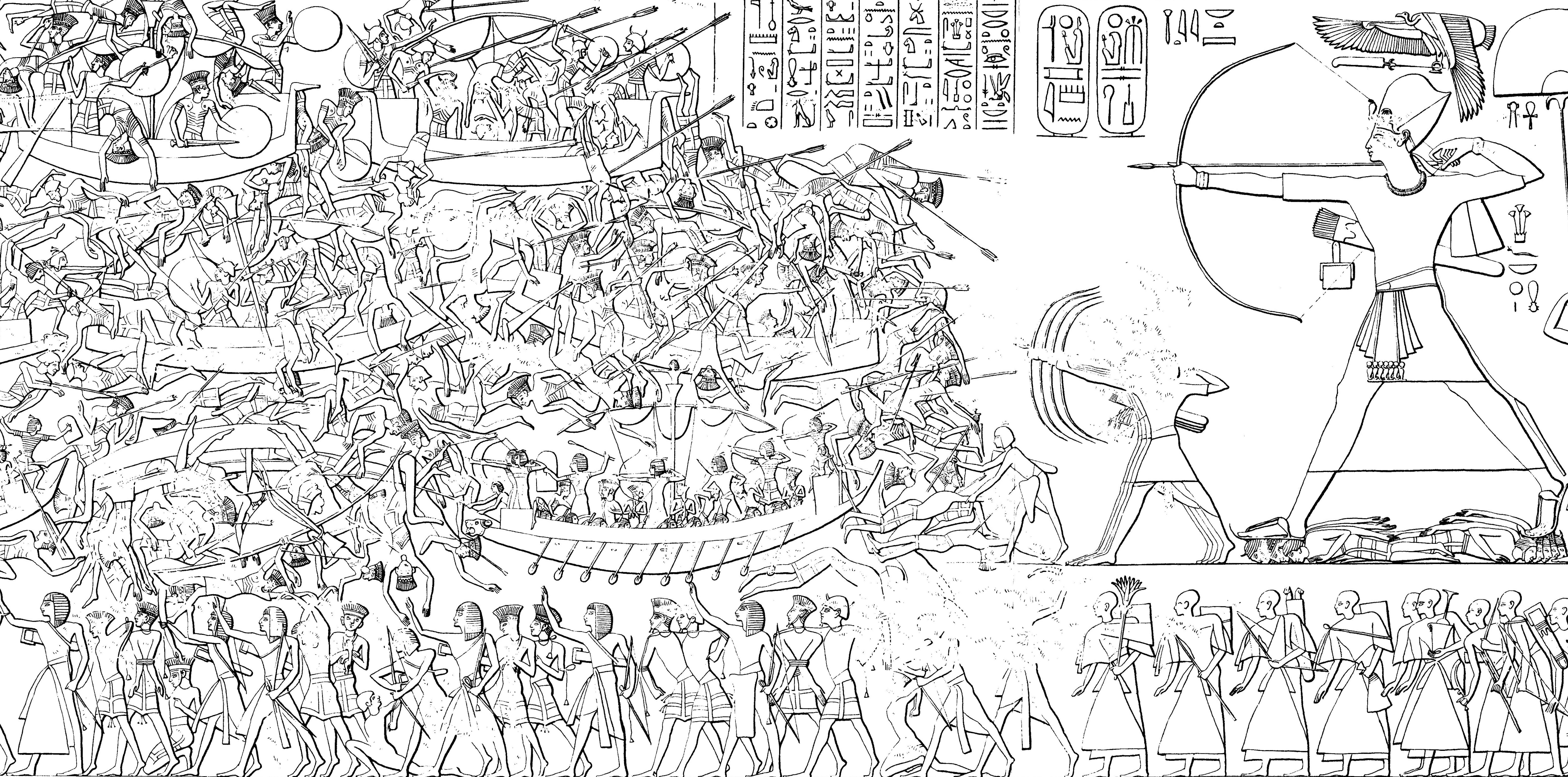
The Battle of the Delta relief at Medinet Habu, depicting Ramesses III defeating the Sea
Peoples. The relief is one of the primary sources of information about the Sea Peoples.
The Egyptian sources provide at least 9 tribes that make up the Sea Peoples; among historians
there is general agreement that the Sea Peoples were made up of a series of different tribes.
However, something as simple as the names of these tribes is yet another point of contention among
scholars. The tribes identified in the Egyptian sources include the Peleset, Tjeker, Shekelesh,
Denyen, and Weshesh, among others. However, because of the etimology of these names, it is
difficult to pinpoint the exact origins of these tribes, and the exact tribes they refer to; this
is due to the nature of Egyptian linguistics, and how they recorded consonants and vowels. Without
clear indication of what the tribes refer to, we have to rely on other information in identifying
the Sea Peoples, including a variety of information such as the material culture of the Sea
Peoples, etimology of the names, historical context of the time, and the depictions of the Sea
Peoples in the Egyptian sources. This is where the first major contention on the narrative of the
Sea Peoples arises, which is where they came from, and who they are. What do we actually know?
Well, we have some evidence that can help lead us to some potential conclusions, but the reality
is that there is no nail in the coffin yet in identifying the Sea Peoples.
[Scholars] found the historical information provided by both the pictorial and textual elements (especially the great inscription on the north wing of the second pylon) disappointingly minimal, and enshrouded by grandiose generalities about pharaonic dominance over foreigners.
David O'Connor, The Sea Peoples and The Egyptian Sources
To illustrate the point, consider the case of the Sherden, one of the tribes identified in the
Egyptian sources. Initially mentioned in the Egyptian sources as mercenaries employed by
Ramesses II, the Sherden are later identified as one of the tribes that made up the Sea Peoples.
From the depictions of the Sherden in the Egyptian sources, we can see that they are depicted
wearing distinctive circular helmets, with a horned helmet with a circular disk on top. Similar
helmets have been found in Sardinia, an island in the Mediterranean, along with other material
culture that is consistent with the depictions of the Sherden in the Egyptian sources. For this
reason, combined with the etimology of the name, some scholars have identified the Sherden as
originating from Sardinia, an island in the Mediterranean. This seems to be like a reasonable
conclusion to make, given that both the name and the material culture of the Sherden seem to be
consistent with the idea that they originated from Sardinia. However, this is not a conclusion
that all scholars agree on; just because evidence is consistent with a narrative does not mean
we can conclude that it is true.
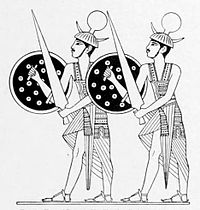
Two Sherden warriors depicted in their distinctive helmets the reliefs at Medinet Habu.
Consider the thought experiment that the Sherden happened to have actually originated from modern
day Germany. Although we don't have any specific evidence to suggest that the Sherden originated
from Germany, from the evidence mentioned above, we don't have much to suggest that this was not
the case. In particular, it could be possible that the Sherden were a Germanic tribe, which split
in a schism, with one group migrating to Sardinia, and the other forming what we now know as the
Sea Peoples, yet maintaining pieces of their original culture. Despite there being a number of
blatant holes in this (very unlikely) idea, it's a good example of how even strong evidence can be
open to interpretation. Namely, in the case of the Sherden, some theorize that the Sherden did not
originate from Sardinia, but the material culture was actually the result of the dispersion of the
Sea Peoples after their defeat at the Battle of the Delta. This is a theory that is not widely
accepted, but it is one that is still considered by some scholars; there is little conclusive
evidence we have to suggest either way. Material evidence is also consistent with the idea that
the region experienced climate change, which may have been the source of food shortages and cause
for migration. This, however, is somewhat of an oversimplification of the narrative; historically,
there are many ways to respond to famine, and migration is not necessarily always the first
response. As you can see from just a simple instance of a helmet, there is an entire rabbit hole
of reasoning you can go through in identifying the Sea Peoples, and this is just one part of one
tribe. The Sea Peoples are a complex group, and the narrative surrounding them is equally complex.
Ultimately, it is important to consider the rhetorical situation of evidence in forming your own
conclusions around the Sea Peoples. As O'Connor pointed out, the Egyptian bias of the primary
sources must be recognized and considered when interpreting the evidence. At another level,
interpreting arguments about the Sea Peoples must also be read in the same way; even scholars are
prone to speculation and trying to form an argument, so considering the evidence, and forming your
own conclusion around what you think is most probable is essential in studying the Sea Peoples,
and archeology in general.