Philistine DNA and Land Claims
The story of the Sea Peoples might seem distant from our modern society, but the ancient world
significantly influences our understanding of the present. Our interpretation of the past shapes
our current perspectives, and one such example is the Philistines – often depicted in historical
and biblical accounts as uncivilized enemies of the Israelites. These narratives often obscure the
fact that the Philistines' origins are entwined with the broader migration event of the Sea
Peoples into the Southern Levant during the late Bronze Age. Historians largely concur that the
Peleset tribe among the Sea Peoples is the progenitor of the Philistine people. While
traditionally seen as antagonists, recent genetic research from Ashkelon, a principal Philistine
city, paints a more complex picture of migration, integration, and cultural fusion. A study
analyzing the DNA of 10 individuals from Ashkelon, spanning from the Bronze Age through the Iron
Age, has uncovered evidence of a significant migration event. This genetic influx, traced to
southern European regions such as the Aegean, Sardinia, and Iberia, coincides with the
archaeological timeline marking the emergence of the Philistine culture in the Levant.
What makes this discovery particularly intriguing is the identification of European genetic
markers in Ashkelon’s early Iron Age population, coupled with the rapid integration and subsequent
disappearance of these distinct genetic traits within approximately two centuries. Such quick
assimilation hints at a narrative of resilience and adaptability, suggesting a harmonious
coexistence between the Philistines and their Levantine neighbors. This narrative emerges against
the backdrop of the Bronze Age's collapse, highlighting how diverse groups came together to form
new communities and identities. These findings offer tangible genetic evidence supporting the
theory that the Sea Peoples' migration contributed to the origins of the Philistines, aligning
with historical and archaeological insights. Secondly, they emphasize the complexities of ancient
migrations, illustrating not just the movement of people but also their subsequent interactions,
cultural exchanges, and assimilation processes. This refined understanding challenges the
simplistic view of the Philistines as mere antagonists and unveils a richer tapestry of human
history characterized by migration and integration.
Unfortunately, not everyone feels the same way when interpreting science and history. Namely,
recently, Beniamin Netanyahy, the prime minister of Israel tweeted about the Philistine DNA study, claiming that the study
confirms Israels claim to the land in the Israel-Palestine conflict.
There’s no connection between the ancient Philistines & the modern Palestinians, whose ancestors came from the Arabian Peninsula to the Land of Israel thousands of years later. The Palestinians’ connection to the Land of Israel is nothing compared to the 4,000 year connection that the Jewish people have with the land.
Beniamin Netanyahy, Twitter
In this case, the prime minister's interpretation of the study is misleading. In particular,
Netanyahu links the study as evidence to the modern genealogy of Israelis and Palestinians, which
is not the case. The study is about the Philistines, a group of people who lived in the Southern
Levant during the late Bronze Age. The connection between the Philistines and the Palestinians is
mainly etymological, rather than any direct genetic connection. The genetic evidence points
towards southern Europe as a likely origin of the migration, but the exact origins of the Sea
Peoples tribe associated with the Philistines remains unclear. It is an important case of
understanding how archeology can be weaponized, and how critical it is to understand the full
context of a study, as well as the direct evidence. For many people on Twitter, the tweet will
seem as though it is backed by scientific evidence, and will be taken as fact. This is a dangerous
precedent, and opens up a deeper conversation about how science should be communicated and
interpreted in the public sphere.
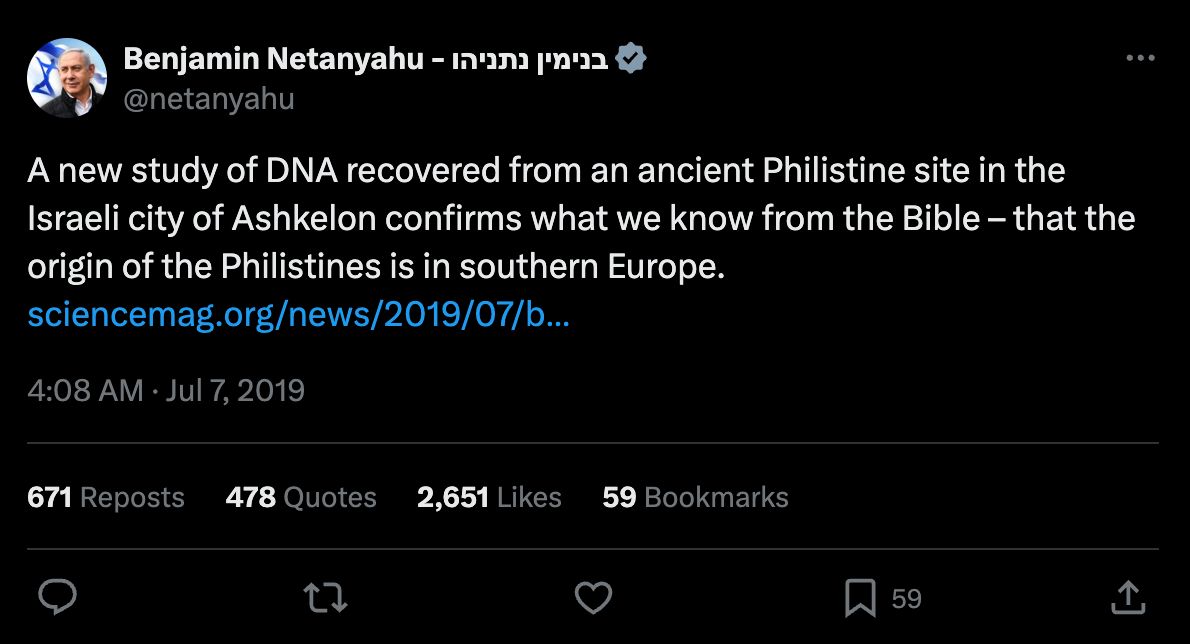
Beniamin Netanyahu, prime minister of Israel, tweets about the Philistine DNA study, in a slightly less misleading tweet.